Everything on model trains, model railroads, model railways, locomotives, model train layouts, scenery, wiring, DCC and more. Enjoy the world's best hobby... model railroading!
Peter Field from Pietermarizburg South Africa sent in an update of his model railway to share with readers.
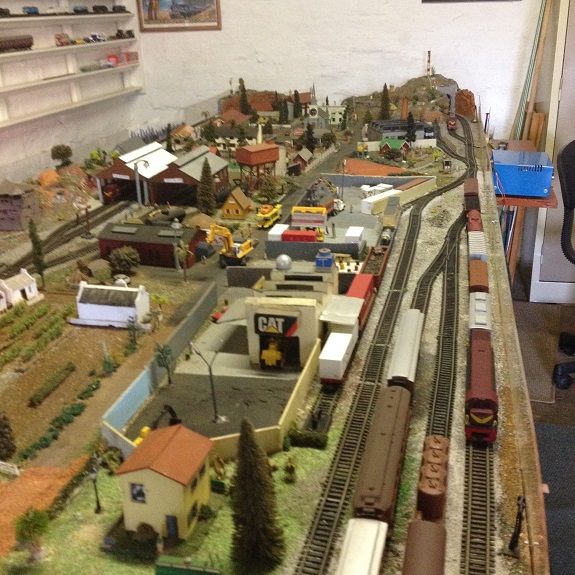
Looking up along the layout at the bottom is the farming area, middle are the factories and top end of the board is the village.
He’s what Peter has to say –
In an article some years ago I built a board which was basically a demonstration board of 1.80x 1.20m that was portable for model train shows.
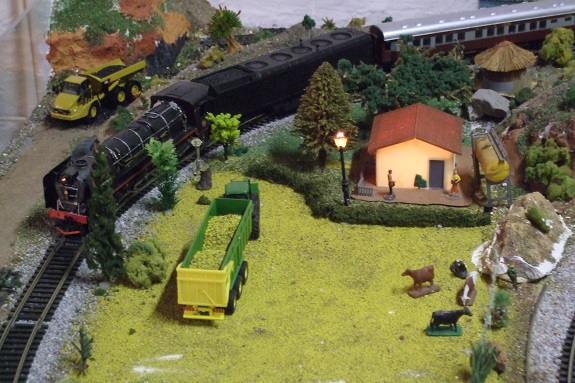
A class 25 Condenser hauling the Trans Karoo passes the Anglo Boer war block House on route to its destination.
The next phase of the building plan was to make it a permanent layout still being 1.80x 1.20m and broke the board up somewhat to modify it and to extend it at a later stage.
In 2013 I started to expand the board and added another 1.80×1.20 board to the existing board which was now 3.6meters in length, this took almost a year to complete and add the scenery etc. Then at the end of 2015 I extended the layout yet again by 500cm making to the total layout 4.10x 1.20meters in size.
The layout was built to represent the South African railways in the early 1960’s up until the mid 2006 period.
When steam and diesel were working side by side on many of the SAR lines. There were the mighty Class 25 condenser locos to the Class16E a Pacific grey hound and the 15CA on many lines mixed with diesels of various types from the Class31, 34. 35, 36 and some SAR electric locos Class 6 E1.
The layout is based on a rural area of the Midlands in Natal with a general dealer, Hotel, Church, Garage and some factories and farms on the one side of the layout all served by rail.
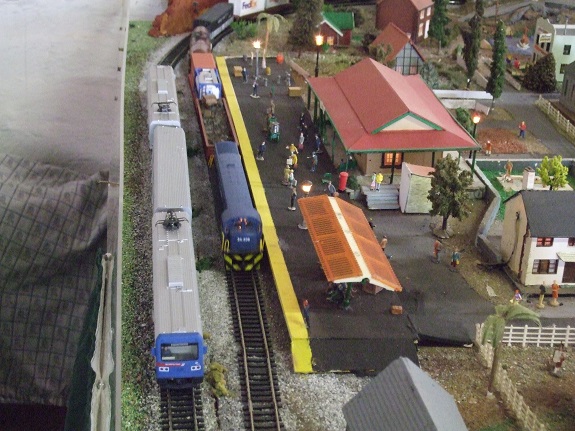
The Hilton station with an EMU on the adjacent line whilst a goods train hauled by a Class 34 diesel glides past the station.
The village has plenty of action with people doing what people do taking dogs for walks people shopping at the grocery store ride motor cycles, people getting married at the church people working on the roads, offloading containers in the container bay area. Plenty of motor vehicles and trucks and farming implements on the farms.
The track in total is +- 8.20min length plus all the sidings along the line which is operated off a dual controller which powers the rails and the 16V supply to the towns lights and street lights etc.
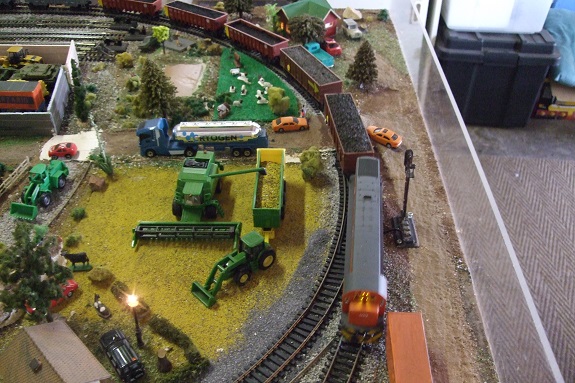
A Coal train being hauled by a Class 34 diesel past the factories with a wine farm on the left.
The trains can vary from the Crack Trans Karoo express to the Blue train or mixed goods trains Coal trains or container trains or even a fuel train as the operate in block trains over here for say coal.
We also have a 1940’s balcony coach train of wooden stock to represent that era with the first diesels imported into South Africa the Class 31 or a fast passenger train hauled by a Class 25 condenser or a pair of Class 34 diesels. There is also an EMU suburban train that operates every so often. Trains are made up in terms of the periods when they would have operated on the SAR. The whole idea was to show what the South African railways looked like in the respective periods.
I call this layout “My world” as it was in my young years to the mid 1970’s when I saw the railways in the period of my life from a young boy to a young adult . There nothing more relaxing than to go into my train room and sit operating trains shunting and making up trains for the next session and to repair trains that are damaged or broken.
Ronald asks readers:
“I’m about to start my HO layout and considering Walthers Code #83 flex track with a couple of sidings. Am I making a good choice?”
Alister asks readers:
“I saw a demonstration of joining a drop wire to a buss. The buss was blue and appeared to be insulated. The guy had a plastic joiner which clamped the drop wire to the buss without removing the insulation on the buss line ( no soldering was needed). How does this work? I was told the buss wires for the different rails were best to be different colors so that there was no confusion when joining drop wires. For the buss lines to be different colors they will be insulated. How can contact be made through the insulation? Thank you.”
Club member Duncan from New South Wales in Australia sent in these planning tips to share –
I’m on to my 2nd layout so thought I would jot down some suggestions for others. Here we go…
The more carefully you think through the planning stages of building your model railway, the fewer problems you’ll have when it’s finished and operational. That’s my experience anyway.
I can’t stress enough, the importance of selecting the right track plan for the space you have available. The cars need to operate without derailing, and the railroad needs a reason to exist, because no trains run from point A to point B without a purpose. Also, I’m sure you’ll soon get bored if the layout is too restrictive, and doesn’t allow for enough operational variations.
 Based on my experience, I would say you should be 100% certain of your track plan, and lay it out on your baseboard before pinning it down. I first pin the track lightly to my baseboard which I make from exterior Water and Boil Proof (WBP) plywood. You can use other materials. I don’t use cork.
I then test for smooth operation and test that the electrics of the track are correct. I do this before starting on the ballasting. This is really important, because it’s too late if you find problems after the ballasting is done. It’s just so hard to rip it up and start again. So check track alignments, wiring etc before you ballast.
As soon as I have finished and tested the wiring, I then test my various locomotives and all my rolling stock on the track. I do this to satisfy myself that the track is laid correctly and that it allows for good running. I hope this helps someone.
Johan sent in this question for readers:
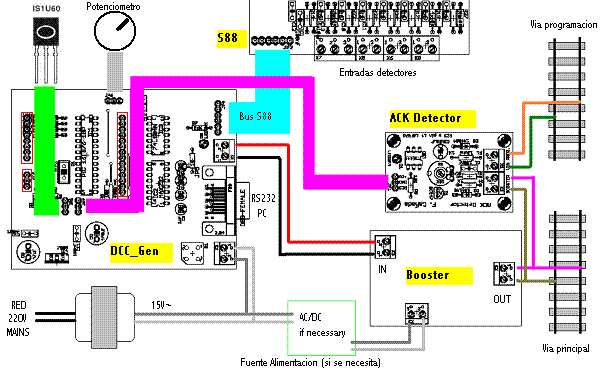
“Thanks for your model train newsletters. I love to read them. One big question, I have my own DIY dcc command station (DCC _Gen v 2c ) with ACK Detector, Booster R-CDE and a Feedback module S88. What kind of DCC hand held controller do I need. I bought my first model train in 1974 the Lima type.”
Bob from the UK sent in this story:
I had until 3 months ago an up and ‘almost’ running layout in my loft, then-I broke my left hip-which shouldn’t be a problem NORMALLY, but it is giving me a lot of grief. On top of that my right hip which was replaced 4 years ago is also giving me grief, on top of that my spine is knackered, there are gaps where there shouldn’t be so I constantly get trapped nerves.
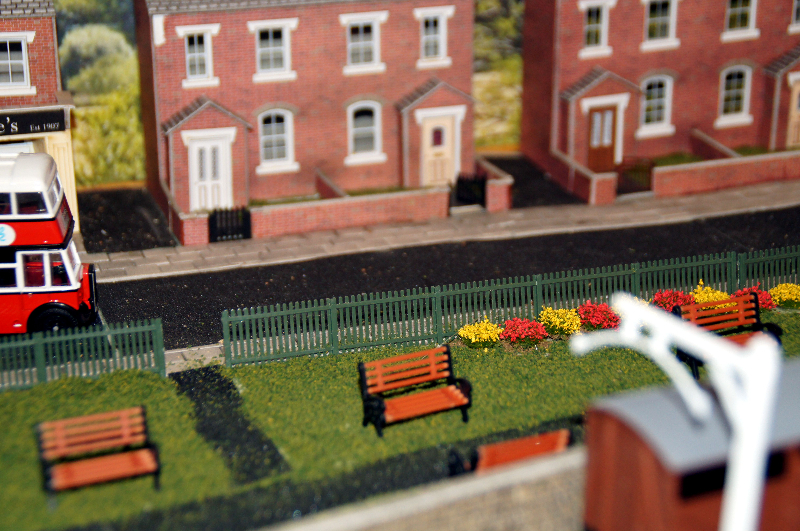
Apart from that I’m ok because I’m able to make single DIORAMAS which is what I’m doing now in my spare upstairs bedroom. Currently I’m making WATERLOO STATION and tracks plus turnouts. This has been a marathon job but I’m determined to finish it and God willing my Left hip will be okay in the future – when ever that might be. Morphine doesn’t help one bit, but with my other hobby Amateur Radio which I have been on since 1978 keeps me sane.
Enough said, I look forward to the future, because there is always hope.
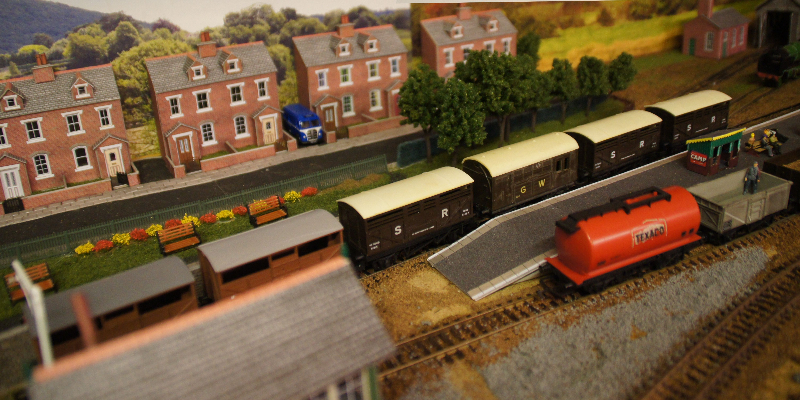
Brian models OO gauge and asks readers:
“I have just purchased a Dapol class 22 diesel and it derails on all points which are Hornby insulated points. All my other engines work ok on these points. Any help would be greatly appreciated.”
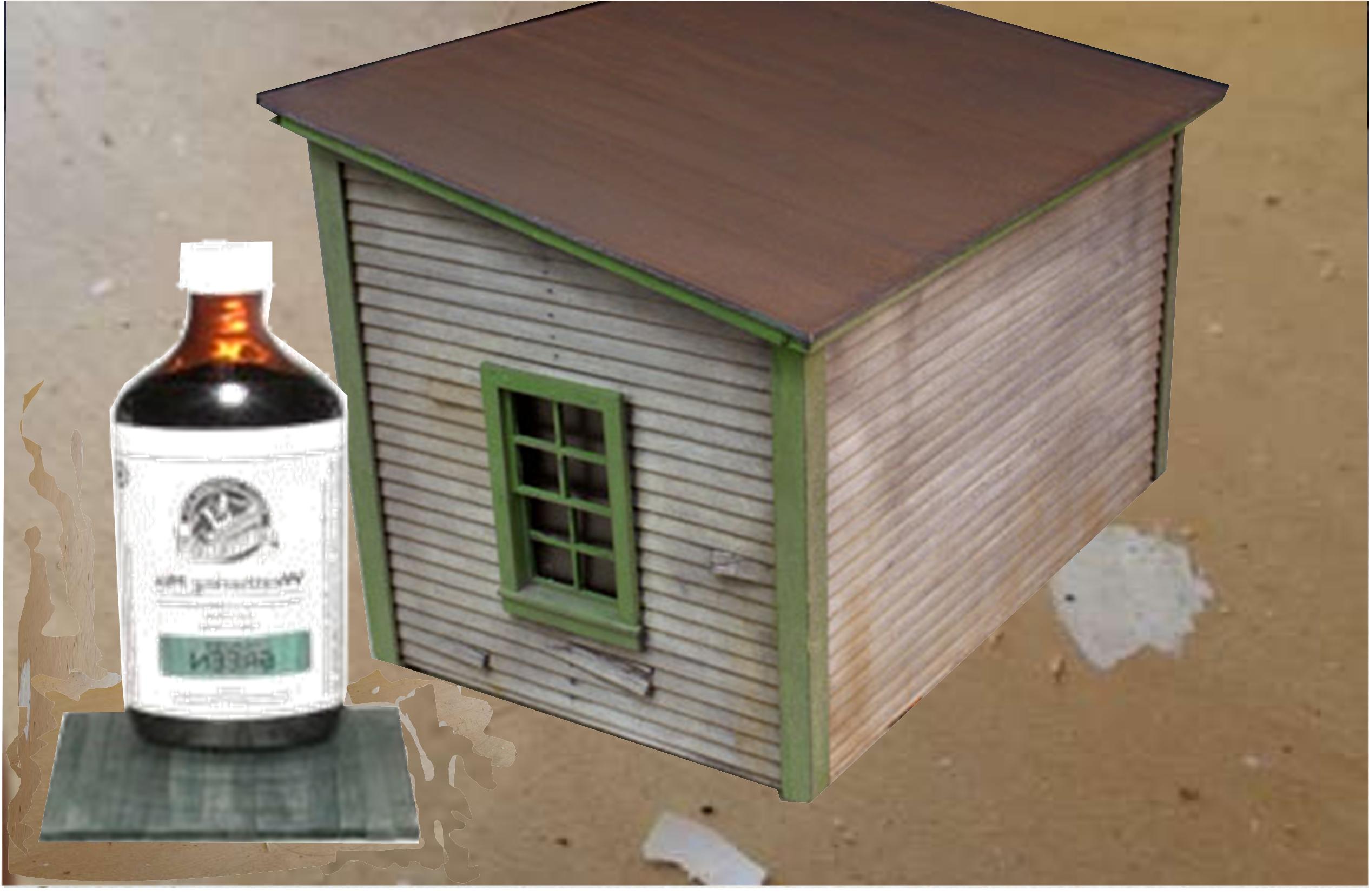 Club member Mal sent in these weathering tips to share.
For a lot of my weathering I use a solution of 1 teaspoon of India Ink mixed with 1 pint of rubbing alcohol (70% isopropyl alcohol). I use this for my LIGHT weathering jobs.
When HEAVIER weathering is needed I use a mix of 2 teaspoons of India Ink in 1 pint of rubbing alcohol. My personal preference is to use the Hunterline bottles of alcohol based weathering which I buy direct online. You might prefer another brand.
I do a lot of dry-brushing as it gives my projects a more “blended” look. To do this I lightly dab my paint brush (it must be dry and clean) in the color. I then brush most of this paint off onto a disposable paper towel. When almost all the paint is gone from the brush I am ready to start dry-brushing the object.
It takes a bit of experimenting and practice to master this technique, but it does look really good when done properly to subtly and slowly build up the paint layers.
Steve used a link on this page to post this question:
“I am operating a 060 Tank locomotive but am having problems on turnouts. At slow speed it stops. When I run it faster it sometimes derails. The loco appears to rise a little as it goes through the points. Has anyone got any suggestions please?”
Add your comment if you can suggest a solution.
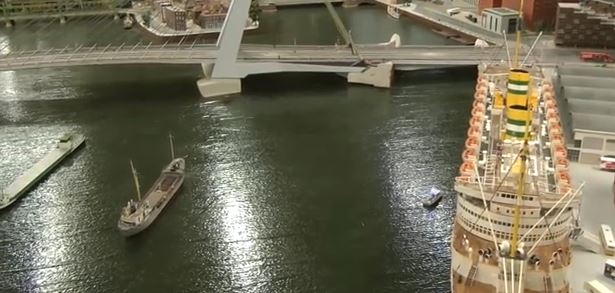
This photo was taken at the Rotterdam Train Show which is the largest model railroad exhibition in the Netherlands.
Dave asks readers:
“I understand a main wire runs under track and every 3 to 5 a jumper wire is attached to the on the inside rail. But is this just the + wire? or both the + wire to the inside rail and – to the outside rail? Any help would be greatly appreciated. Dave”
Phillip asks readers:
“I am thinking of making an N scale layout and I have stacks of telephone wire, and I was wondering if telephone wire would be okay for wiring up N scale layouts. Thinking of a U shape layout about 3m x 2.26m x 0.7m in the garden shed. As the motors are a lot smaller than ones in HO scale, there would not be a lot of electricity going through. Can any advise if telephone wire will be okay?”
Timothy asks readers:
“I have several HO engines that the front wheels jump the track, even on straight sections. They act like there is a spring missing that may hold wheels to the track. I don’t see where there is any place to put them (springs). Not just one brand either.”
 Here are three different body styles seen on Pacific National diesel locomotives. In front is the cab unit; the middle is the hood unit; with the box cab at the rear. Sure to bring back some memories for some.
Lester model N scale and asks readers:
“I like to know how to wire a DPDT switch. I own a DCC system NCS. I want to make a section on my main track as a program track. It is isolated from my main track. What I need is a diagram on how to wire it so that the program track becomes a main track when it is thrown on and the other way the program track has power and the main doesn’t.”