Construction
Everything on model trains, model railroads, model railways, locomotives, model train layouts, scenery, wiring, DCC and more. Enjoy the world's best hobby... model railroading!

Gordon want to hear from you if you are experienced in the hobby and asks:
“I am building a new HO set for my grandson and wish to use a 10′ x 4’6″ base board. As this is too big to get through doors etc I was going to cut it in half and then join it together on location. Does anyone have any ideas on an easy way to line up the tracks if I need to separate to remove them from the present room and reset up? Should I work on the basis that the board is permanently in one piece once joined and the rails are fixed? Aniticipating future moves of the board is my problem. The rails are not fixed to the board at this time but I am starting in next couple of weeks.”
Take part in the discussion. Add your thoughts to this posting by using the GREEN COMMENTS link below.
Buzz has a question that has been asked before on this blog (use search box to see previous postings on the subject). Readers are welcome to give their thoughts on the most appropriate height:
“Can some please inform me what is the finished height from the floor to the platform for ho scale. I am now in the process of putting the legs on my frame.”
Add your comments below.
Barrie has a question for readers to try and answer:
“As a beginner in the model railway hobby I am just about to begin to lay track. The person who sold me my 36″ track also suggested a ‘rubber’ type of underlay. The difficulty that I have is that the underlay does not bend around even slow corners without crinkling on the inside of the bend. Is there a way to rectify this or is cork a better article for curves?”
Add your comments below.
Melvin asks readers:
“What else can I use for roadbed, other than cork?”
Comment below.
David asks readers:
“I am only getting ready to start a layout. I have built 3 section frames (two 7′ x 8′ and one 7′ x 14′) in my garage that I have on pulleys raised to the ceiling. My question is what tips can people give me for making the sections come together and work properly?”
Add your comments below.
Ruth is hoping some thoughtful model railroaders can help with her model railroading question:
“My husband and I (in our 60’s!) are beginning to build our first permanent platform. We have decided to use O scale as they are easier for me to handle (arthitis and RSD). I am doing the searching for landscape materials. I am having an extremely difficult time finding vehicles, etc. as most people seem to be into HO and N scales.
Our platform is going to take up a room 9′ x 11′ and we have found the smaller scales derail often, they would be very difficult to reach. Also, my husband had Lionel trains when he was a child. As we have already invested a lot of money in houses, etc., it is too late to change our minds now anyway!
Any advice on sources for buying supplies (not too expensive) and getting advice on constructing our scenery would be very much appreciated?”
Add your comments using the green comments link below Ruth’s posting.
Mark is planning a DCC layout and wants to hear from anyone who has DCC and layout building experience:
“I am re-entering the hobby after a few years. I am going DCC, and looking at using foam rather than plaster – better for the system. What I don’t understand is the use of foam and wiring through it. Should I put down a plywood base, then add 2″ of foam? How do you anchor the risers on top of all of this, and how difficult is it to run wiring through the foam?”
Add your comments below using the green comments link.
Ron asks:
“I am making a double helix and am not sure the best way to support the rise and turn around?”
Add your comments below.
Jim asks:
“What is the best way for a beginner to ensure a level, continuous base for the track layout?”
Add your comments below.
A reader asks:
“What is the best way to attach shelf benchwork to a wall? I will be running brass engines and I am hoping the shelf can be as much as 3 feet wide.”
Add your comments below.
Graham has a question is is hoping an experienced model railroader might help him with:
“I am a new model railroader and need advice on catenary installation. Is it worth installing, does and donts, pitfalls, what to use etc.”
For those who don’t know the catenary is the system of wires suspended above the track, which supply power to electrically powered trains.
Graham, perhaps it might be helpful if you could click on the green comments link and add some more details to your question, as it might help others to supply you with a better quality answer.
Sam wants to hear from others in the hobby and asks:
“I have started on my layout and I’m using Sievers Benchwork. I have started with a turntable and Roundhouse. The turntable is Walthers 130′ and I will sit it in 2″ foam and will use 1/4″ plywood/w/1/2″ Homasote. I will use ceiling tile rail to hold in place. That way I will be able to lift out and clean or preform maintenance when necessary. I just wanted to know if your readers think that should work?”
Add your comments below
David wants help for anyone with experience of repairing loco frames and asks:
“I have a lionel 262e with a broken frame. I want to try repairing it with epoxy and wonder which epoxy would be the best. Has anyone had success repairing frames?”
Use the green comments link to help David.
Nick wants to hear from any reader who has constructed a helix and asks:
“I want to build a helix, but am having difficulty getting comprehensive information. I have, however, discovered it will need to be a minimum diameter of 5 feet. I have also discovered that hardboard (subfloor sheeting) is the prefered substance to use. There are several schools of thought as to shape, risers, etc. So, the question is – Are there any plans for the construction, or will it BE, mostly trial & error?”
Add your comments below using the green Comments link. Then register if you haven’t yet done so. It is easy and takes just 2 minutes. Then you can participate in future train discussions for free.
Jimmy has a question a kind reader might like to answer:
“What is the most effective track base for an ho layout? (including materials)”
Use the green Comments link to add your suggestion. You will need to register first (if you haven’t already done so) and then in about two minutes you can participate in this and future blog discusions.
Norm is about to build a train table and asks readers for suggestions:
“I am starting to build my new train table lay out I’m using 4′ x 8′ plywood sheets on a 2” x4” frame. I’m debating on how high the table should be. I am thinking 36”long legs & the overall thickness of the plywood / insulation board is 1 1/2 ”which would give me a table ht. of 37 1/2”. “
Use the Comments link below.
Tom has kindly sent in this tip for S Gauge (1/64 scale) enthusiasts:
“These are a couple ways to build a sturdy but light platform. If you buy standard metal wall studs at the home center, say 10 ft. long, use these as the main outside and inside horizantal supports. You can put standard wood 1×4’s between the metal studs for leg support.
For the decking, take a hint from the Aluminum patio enclosure people. The roof sections they use are 4inch foam with thin sheets of aluminum sheets glued to top and bottom. Incredible strength. In the railroad application, use 2 inch or 4 inch blue or pink foam board and sandwich between thin sheets of plywood. You can glue more foam board on the top for the landscape.”

“We all know it’s like working under your layout when you have age and knee problem. What I have done with my lay out 9ft X 5ft is I built it in two layers. The top is hinged to the bottom layer so when I want to work underneath all I have to do is hinge the top layer up, lock it in place with a strut at either end and I then can sit on a stool underneath and wire quite comfortably.”
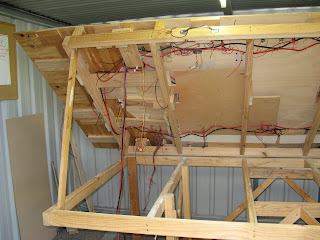
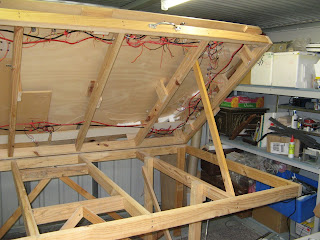
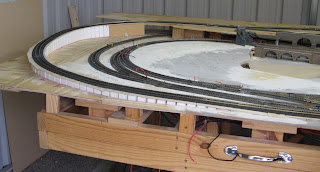
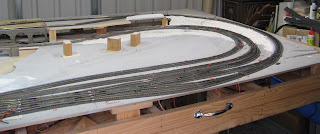
I’m sure this tip will be a big help for many, especially those who are getting on in years or struggle with mobility. Well done John for sharing this helpful tip. It is very thoughtful!