Everything on model trains, model railroads, model railways, locomotives, model train layouts, scenery, wiring, DCC and more. Enjoy the world's best hobby... model railroading!
 Reg wants to hear from someone who can advise him. If you think you can help, then please add your comments to this posting:
“How do you isolate the front and rear lights from grounding, also the body when you replace the four screws. I fitted a tcs decoder it worked fine until the body was replaced. It burnt out the decoder because of grounding of the lights. My scale is HO.”
Add your answer.
 Some in the hobby would say the most important requirement for a smooth running model railroad is to invest in good locomotives. Yes, good quality locomotives are essential if you want to operate your layout with the minimum of stoppages. However, there are several other key elements including: well laid track with correct gradients, adequate power for the number and length of trains, and a workable and interesting track plan. This list could go on and on, because when everything is done well it reduces the risk of problems occurring. Just one thing (e.g. a poorly aligned track) can minimize the effects of the elements that are operating efficiently. There’s an old saying, “you’re only as good as your weakest link!” It’s true!
It goes without saying that scenery is also important. If the scenery looks artificial it can spoil the entire layout. Buy or make realistic model railroad scenery to preserve the originality and add miniature figurines, and appropriate automobiles etc to make it look even better!
For excellent ongoing tips and ideas join the Online Model Train Club – it’s proving very popular and is improving every month.
Graeme wants advise from other in the hobby.
“I am rejoining the hobby and looking to buy a DCC controller. I am currently setting up n scale modules, so they can keep expanding, with intention of computer interface to operate some of the trains while I do the shunts / specials etc. In total I plan for about 10 – 15 loco’s, and I was going to buy a 8 amp unit but have been told recently it might damage to locos and that I should keep to a 5 amp maximum. Does anyone have any experience / advice regards this?”
Add your comments or advice to Graeme’s post.
We have al ready talked about some ideas for creating a fake fire scene on your layout. The smoke unit and all the LED lights will help bring the scene to life and can all be controlled by one switch. Remember not to leave the smoke unit on too long as the smoke fluid could dry up and damage the smoke unit. To add even more reality you can blacken some of the windows in the burning building or at least dirty them so that some look damaged or broken.
You can complete the scene with fire trucks, a crowd of bystanders, fire hoses spread in all directions, and some sounds of fire crackling and / or siren sounds. There are various sound modules available to provide the sound effects including: Maxx Traxx, Dreamplayer by Pricom, HQ Sound Modules manufactured by ITTC, RAM digital sound devices, and Surroundtraxx sold by Soundtraxx.
Ted has a question for others in the hobby:
“I am trying to make a large evergreen logging forest and would like to make my own evergreen trees of 3 to 8 inches in height similar to those from Grand Central Gems. I would appreciate any tips. Thanks.”
Please add your comments.
 Smoke effects can be generated by using a fixed smoke generator – Vollmer, Faller and Seuthe manufacture units of various kinds. One of these units may helpful if you want to create a simulated fire scene in a house or building.
You can begin by making a rough hole in the roof and have some charred burnt visible boards visible as though they are ready to collapse. Areas surrounding the hole and above the windows etc., can be airbrushed with a flat dirty black paint-wash to simulate the soot. It is usually best to paint the complete interior of the building flat black, so the fire won’t show through the walls, as this could look unrealistic.The smoke generator and flickering lights and sound effects can bring the scene to life.
 Modeling a fire scene for model railroad can be done in many ways. LED can add a dramatic effect as can fake smoke and animated fire vehicles or crew. I once heard of someone constructing an entire area with fireproof materials and make a setup for a real fire; however that is potentially dangerous and NOT recommended. It could damage the entire network and pose serious security threat to house and family.
The safer option is to use Circuiton Firelites Flickering Flame Circuits (depending on which of three units you use) for fake fire effects. The FF-1 unit is for smaller fires and utilizes only 1 amber bulb. The FF-2 unit uses red and amber bulbs. The FF-3 can have up to 20 bulbs, which is perfect for a larger fire in a structure, or perhaps even a forest fire.
GRS Micro Liting manufacturers the Micro Flamemaker ideal for small fires requiring 6-12v AC or DC. The Super Flamemaker is for bigger fake flames and is 16-20v AC only. The grand daddy of them all is the Ultimate Flame Master, which is ideal for larger fake fires or even to simulate burning embers. It is 12-20v AC or DC and uses up to 6 – 3volt bulbs. Connecting an AM radio to one of the units is one way to simulate flickering effects.
 How to start collecting model trains and build a fascinating collection? Unlike, many hobbies, model train collecting should be done with planning. Random shopping for great deals may help you to get some excellent models but this is not a good idea to build a great collection.
To build a great collection, you need to focus on a theme and start collecting popular models based on it so that your collection will look complete. Model train collecting can be an expensive hobby, so it is not recommended to collect without a focus as your collection will always feel incomplete.
 If you are about to build your first modular train layout, it comes without saying that it can be a fun experience. However, you can start making your task easier, provided that you follow these few simple but effective principles:
1. Your modular train layout should be able to be moved, so that you can easily transport it if you shift home or if you want to display your layout at a club or show.
2. Always prepare your modular train layout to withstand heavy and rough usage as parts can get knocked around in the transport process.
3. Every module that you make should easily connect to when the time comes for reassembly.
Following these effective 3 basic tips will surely help you to make a fantastic modular train layout. However, this really only scrapes the surface as there are lots more ideas to making building and operating a modular layout much easier and more fun. The member’s area of the online model train club has lots of excellent ideas including the excellent “Confessions of a Mobile Train Layout Builder” ebook.
 Model railway movements look amazing with large traffic sections, railway stations, busy classification yards, and multi-layer landscapes. If you want a fantastic looking railway movement, you need to decide a specific theme as it will keep you stay focused throughout the entire process.
It is also worth noting that multiple high traffic sessions are not recommended for beginners as it can sometimes cause accidents. Although, model train accidents look exciting in videos, they are true disasters in real life, costing you a lot of money.
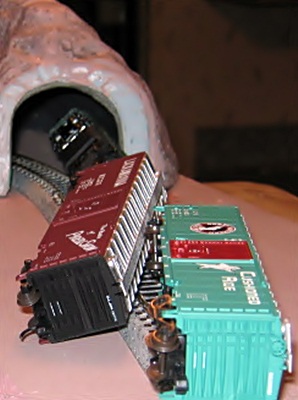 Regular blog reader John makes a wonderful contribution to the model railroading community by sharing his ideas so others in the hobby can benefit. Here is John’s latest article:
A common cause for a derailment is that the track was not put down properly. This could be an upturned rail joiner, particles from the ends of cut track that have lodged in the wheels of the locomotive or cars, dirty track, a “foreign object” that parks itself in the right-of-way, and pinched curved track that does not form a smooth, even circle. This problem becomes even worse when the wreck occurs inside a tunnel.
The first task is to get the cars out of the tunnel. If the tunnel is fixed in place and you model in a small scale, there might be a problem getting your fingers far enough inside the portals to reach the cars, but this can be remedied. Using a soft-bristled toothbrush, attach the non-brush end tightly with tape to a coat hanger to get the length, then SLOWLY and CAREFULLY pull the cars toward you with the soft brush. It might help if a flashlight is put at the other end of the tunnel to see the trapped cars. Once everything is out of there, put the same toothbrush in a bottle of liquid track cleaner and clean both rails inside the tunnel.
The last step is to check the track and to make sure the portal and tunnel is tall enough and wide enough to accept the largest car in the roster, especially around curves. Also inspect the wheels of the cars to ensure that they are riding on the rails properly, as one misaligned wheel can derail a whole train.
Thanks John!
 If you are new to model trains, consider investing in diesel locomotives as some in hobby claim they run better than similarly priced steam engine counter parts. Others in the hobby might disagree. You have the option of cargo and passenger cars, with complete kits available.
The rails come in various options, but many prefer nickel silver as it ensures better conductivity.
Scenery can be a big investment if you don’t make most of it yourself… it’s fun making scenery!
Always invest in the best engine as you can, and then go on to build the required landscape. The idea here is to create a perfectly running model railroad, otherwise all your efforts on creating a classic model might go in vain.
There are several excellent resources available for beginners (and experienced) hobbyists, including the “Best Selling” Model Train Help Ebook. Model train enthusiasts can also benefit greatly from access the numerous resources inside the online Model Train Club.
 Model train hobbyists in New Zealand follow a wide range of scale sizes and most websites make certain that locomotives, cars and tracks are available throughout the country. However, if you are looking for a track size that is regarded as standard, HO scale is a great option for you as it is widely popular.
There are model train clubs throughout both the North and South Islands of New Zealand. Established clubs include: the North Shore Model Railway Club Inc, Tauranga Model Railway Club Inc, New Plymouth Model Railway Club Inc, Wairarapa Railway Modellers Inc, Hutt Valley Model Railway Club Inc, Nelson NZR Modellers, Christchurch Model Railway Club Inc, and the Otago Model Engineering Society Inc. If you’re a Kiwi (New Zealander) reading this blog posting and would like to add further information, then please add your comments to this posting.
 If you have a model railroad question you would like answered, then use the link on this blog to submit your question. If you word your question carefully and provide some useful details, then chances are someone reading this blog will offer a solution. Only the best question will be published. Please spell check your question before submitting it to the blog moderator for approval.
The link to submit your question is on this page.
 Shopping for model train storage boxes is not a very difficult job because most companies that focus on this sector have high quality foam used in the inside of these boxes to protect your cars from damage. However, a few things that are not taken into consideration while buying model train storage boxes can result in forever disappointment. To begin with, it is important to buy a storage box that stores your cars in the STANDING POSITION! This prevents leaked oil spoiling the paint job and costly decals.
If you are on a budget, you can you can use those inexpensive plastic containers you’ll see in most discount stores and line them with foam. Another option is to construct some shelves and store your trains behind glass to keep them away from the dust.
 It is essential to make use of diagrams in the design of model train circuits because a diagram can help you to do the job with no errors and in the unfortunate event of a faulty circuit, you can go back and refer to the diagram to diagnose the issue. Designing own circuits is recommended only for advanced users because thousands of diagrams for circuits can be found on the internet. Make sure that the color codes for resistors, flashers and electrical supply etc., are accurate from user comments and your own common sense.
Rob sent in a request for advice and asks:
“Right now I do not have a layout. I am in the process of building one. What I need is some ideas of layouts. I am limited to space and as of right now all I can have the layout on is a 4×8 board.”
Add your comment.
Mike wants advice from readers and asks:
I am constructing a 5×10 foot O scale layout with TCC that will be set onto a 4×9 foot dining room table, with a separate power/control free standing console that would be detached and stored separately. What equipment would provide best connectors, reliability and value…and how best to be done? The layout would have some switches, and a few operating devices such as signals. Nothing fancy…just getting my grandkids into playing with trains at a young age.
Add your comment if you can help Mike.