Everything on model trains, model railroads, model railways, locomotives, model train layouts, scenery, wiring, DCC and more. Enjoy the world's best hobby... model railroading!
John has kindly sent in this story for publication:
Coupler problems is a subject very near and dear to me. On British trains the couplings on the older stock ( I am modelling the late 1940s) were screwed up tight. Coaching stock with gangways coach to coach were very close. If models are shop bought then they are designed for 2ft radius curves i.e. the toy market. But my layout will only have a few curves as tight as 3ft radius on turnouts ( sorry “switches” in your language). So not wanting my trains to have about 10ft between coaches I am working my way through my stock modifying couplings so as to have that “bunched-up” look to my trains. With experimentation I have decided to aim for about 5/32 of an inch between buffer faces. This gives satisfactory clearance for 3ft radius curves (00gauge).
The trains look really good at this and the gangways are so close as to appear joined. I know that joined-up gangways are available and perhaps I will at some point fit them. But I do have reservations in this regard not wanting to detract from the ease of changing coaches in a train.
The flexibility of the make-up (what I believe you call “consist”) was a feature of the old-fashioned loco-hauled trains of my era. If a train arrived at a junction station then one or two coaches could be added if there were through coaches from the branch or a coach or coaches could be transferred from the main line train to the branch. Luggage cars and parcels vans could be transferred from one train to another and so on.
The modern diesel (and electric) trains in their rigid formations have lost this flexibility, a flexibility which was responsible for attracting the public to use trains. The Great Western Railway was famous for its slip coaches for example.
Here in Britain we have lost all our branch lines, there is very little freight movement and I am sure that you will be aware that it is freight that makes a railway profitable. We have all but lost our manufacturing industry, factories close down on a daily basis, are dismantled and become supermarkets, housing estates and warehousing for imported, foreign-made goods which the British public in general, cannot really afford!. This is because everything we buy of a manufactured nature is made in China.
Mail, oil, food, even refurbished railway coaches, ALL go by road, even carrier racing pigeons are sent out by road now. Our roads are cluttered up with huge lorries far too large for our little thoroughfares.
Yet the railways are under ever increasing pressure to carry more and more passengers on a railway which is a bare skeleton of what our railways once were. I am sure that the press of numbers of passengers is not because the public is ATTRACTED to trains but simply because our roads are so crowded now that journeys on those roads have become so unpredictable due to the press of more and more cars. We are fast becoming the most over-crowded country in the world and soon the railway train will be the only satisfactory mode of travel. Even the skies have become overcrowded with aircraft!
I have rather got off the subject of couplings but hope you will understand that I want to model a REAL railway!
David has a question for readers on locating a faulty rail connection. David says (in his words):
“This question comes from a complete idiot where electrics are concerned! Is there an electrical meter I can purchase which will quickly locate a loose rail connection which in turn is causing loss of power to the track? Would a continuity meter be the answer or am I talking nonsense? I have never used a multimeter if indeed that is the answer so I am hoping for something even an idiot like me can use. Any help would be greatly appreciated.”
If you can assist David, then please add your comments below.
Mick has a question for anyone who can answer it:
“I an setting up my first DCC N-Scale layout using Peco code 55 Track on Woodland Scenics track bed ST1475. I am also using Peco switches. However, my locos (e.g. InterMountian FTA/B pair) usually sits and spins the wheels on the track – conductivity, but no traction. There are also spots where the 16v DCC is present (as measured using a VOM on AC setting), but the train sits. What can I do to correct this BIG problem?”
Add your answer or feedback below.
Paul is having trouble locating decals and asks readers:
“Where can I find decals and transfers for PRR? Haven’t had any luck finding sites with them.”
Add your feedback and suggestions below.
Antonio has a question on HO train couplers:
“What is the best and easiest way to transform American style locos with kaddee style couplings into european style rolling stock with standard (european) couplings and buffer beams?”
Comment below.
Fred has a question for those who have already converted to DCC and asks:
“My HO track setup was huge project for me, being a first time model railroader. It is a C shaped setup that is 8′ x 12′ with a 4′ x 4′ square cut out in the middle where the control board is located. I forget how many feet of track there is, but it consists of four separate power systems that are all connected so I can run a train off one system on to another system.
There is also an elevated track looping around the entire setup. The control board I designed myself and is extensive. There are the four transformers for the four separate systems, and then another four transformers to power all the switches and lights (the lighting system is very extensive and requires a lot of power).
My question is what is involved in switching to DCC? I have so much work as well as money invested in what I have now but I read about the things that you can do with DCC that it makes me really interested in making the switch. But I know nothing about it and what I have to do to make that switch. How much of my control board can I use and what needs to be removed and replaced? I know the answer would be pretty involved, but I’ll take whatever advice anybody can contribute to this question.”
Add your feedback below.
Jeff has a question for experienced model railroaders and asks:
“When starting out, do you lay down your tracks first to get an idea of how it will end up?”
Comment below.
Mike has a question for anyone with experience in oo gauge tunnel and bridge building:
“In oo gauge, what are the tunnel and bridge safe heights?”
Add your suggestions below.
Merl has a question for anyone who uses flex track:
“Now I know this is a pretty basic question, but in starting to work with flex track, I had problems connecting sections together. Do you have to remove ties to put on rail joiners? Is there some trick to working with this track?”
Add your suggestions below.
Ray asks readers:

"Does anyone know of another method of contoling Semaphore Signals? I use RR&Co 7 Gold with Digitrax Chief to control my DCC system. I use SE8c controllers for my signal lights. I chose not to use the SE8c for the semaphores because I can't get the Tortoise drives under my middle and top track levels and clear the trains below. I am using the SMC4 boards with RC mini servos that tuck under easily. The SMC4 operates the semaphores with (3) addresses and 'throw commands only'. I have had to use a (3) aspect signal for the first two addresses and a (2) aspect signal for the third. However,the SMC4 works only upon an actuation signal with no memory. This causes some problems. Does anyone know of another method of contoling Semaphore Signals, or do they know of a smaller stall motor drive to replace the toroise?

Comment below.
Neil asks readers for advice:
“I am looking for marker lights for on the front of the boiler and piping details under each side of cab for top of the line Norfolk and Western J type O locomotive. I want to upgrade my N&W J type Williams by Bachmann locomotive as I have done on my Lionel model. It took a LOT of guts to drill holes in the Lionel boiler to mount the marker lights. The piping details had to be slightly modified in order to fit under the sides of the cab, but the results were well worth the effort.”
Gino asks readers:
“Could someone please help me. I purchased a Heljan container crane and all the functions work except for the hoist which will not go up or down. Has anyone had this problem and if so how did you fix it? Thank you.”
Comment below.
Charles has a question for readers:
“When making up a long coal train of hoppers, why do the Athearn Cars seem to be out of proportion? They always appear to me to be larger than hoppers produced by other manufacturers. Am I imagining things?”
Comment below.
Daiquiri asks readers:
“I am looking for the builders of the new Amtrak Auto Train Carriers. I am creating an HO scale Auto Train and have to scratch build the auto carriers. I need plans, diagrams or blueprints so I can obtain the dimensions of the cars so that I can reduce them down to HO scale.”
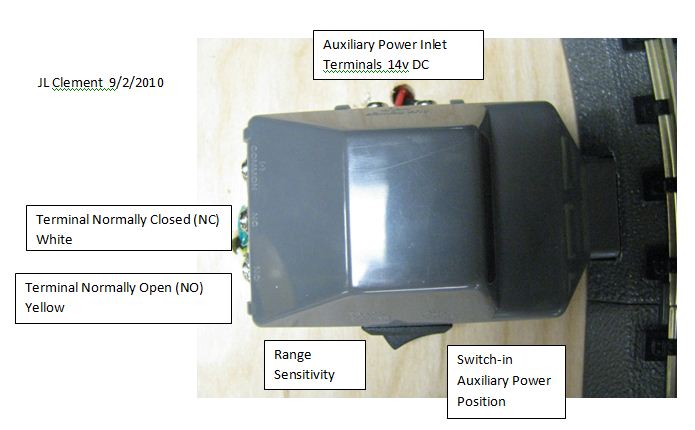
Jack has put considerable thought into submitting his question so I am sure you’ll want to help him if you can. Please use the green comments link below Jack’s posting to add your comments and suggestions.
Jack says:
I am sending details of the “O” gauge crossing gates arrangement I have installed which the hope of receiving guidance on modifications required for proper operation. The arrangement uses the RailKing (RK) Crossing Gates in conjunction with a MTH RailTrax I.T.A.D. (ITAD) Control. A wiring diagram and photos describe my installation which does not function and displays the following characteristics:
1. The setup is based on using Auxiliary Power from the 14v DC terminals on the transformer.
2. When the auxiliary power is turned on, the Flashing LED lights start blinking and do not turn off.
3. The gates freeze in the down position as shown on the photo.
4. When the locomotive passes through the crossing, there is no effect on the gates.
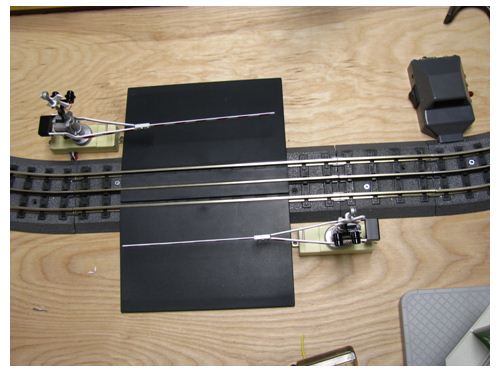
The installation was in accordance with my interpretation of the two sets of operating instructions- Gates and ITAD. I had to make some assumptions:
1. The gates and the ITAD required both to be directly powered from the transformer.
2. The input terminals on the ITAD were interchangeable, ie, either could be the positive terminal.
3. As auxiliary power is selected on the ITAD switch, it was of no importance for the ITAD to be on the same side of the track as the Lock-On for track power.
4. There is not direction about the location or orientation of the ITAD, nor any information on considerations for the infrared sensing circuit. I expected to see a red light on the ITAD but see none.
5. That the components are in good working condition.
The Operating Instructions for the Gates and the ITAD are attached.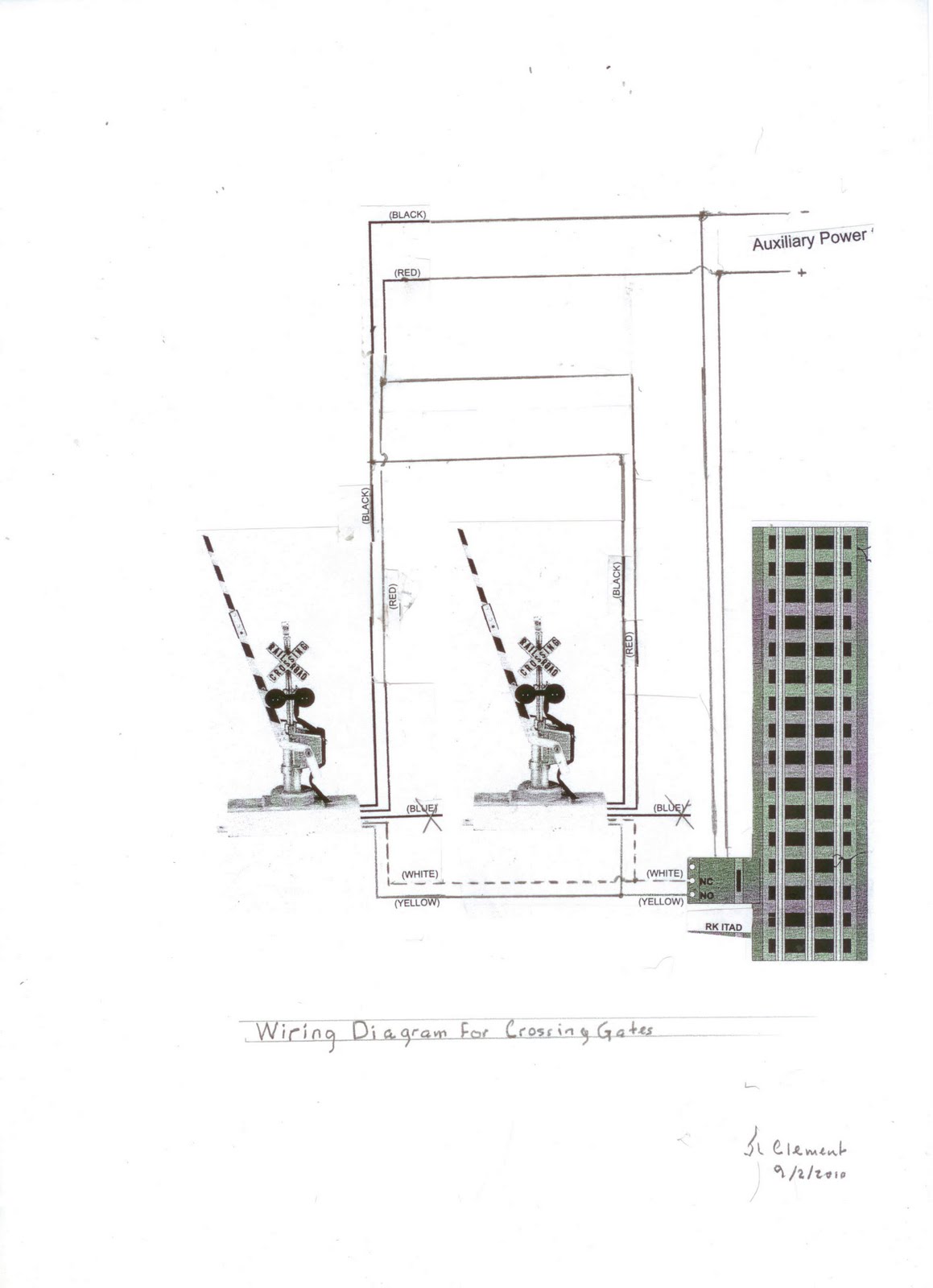 Crossing Gate Wiring Diagram
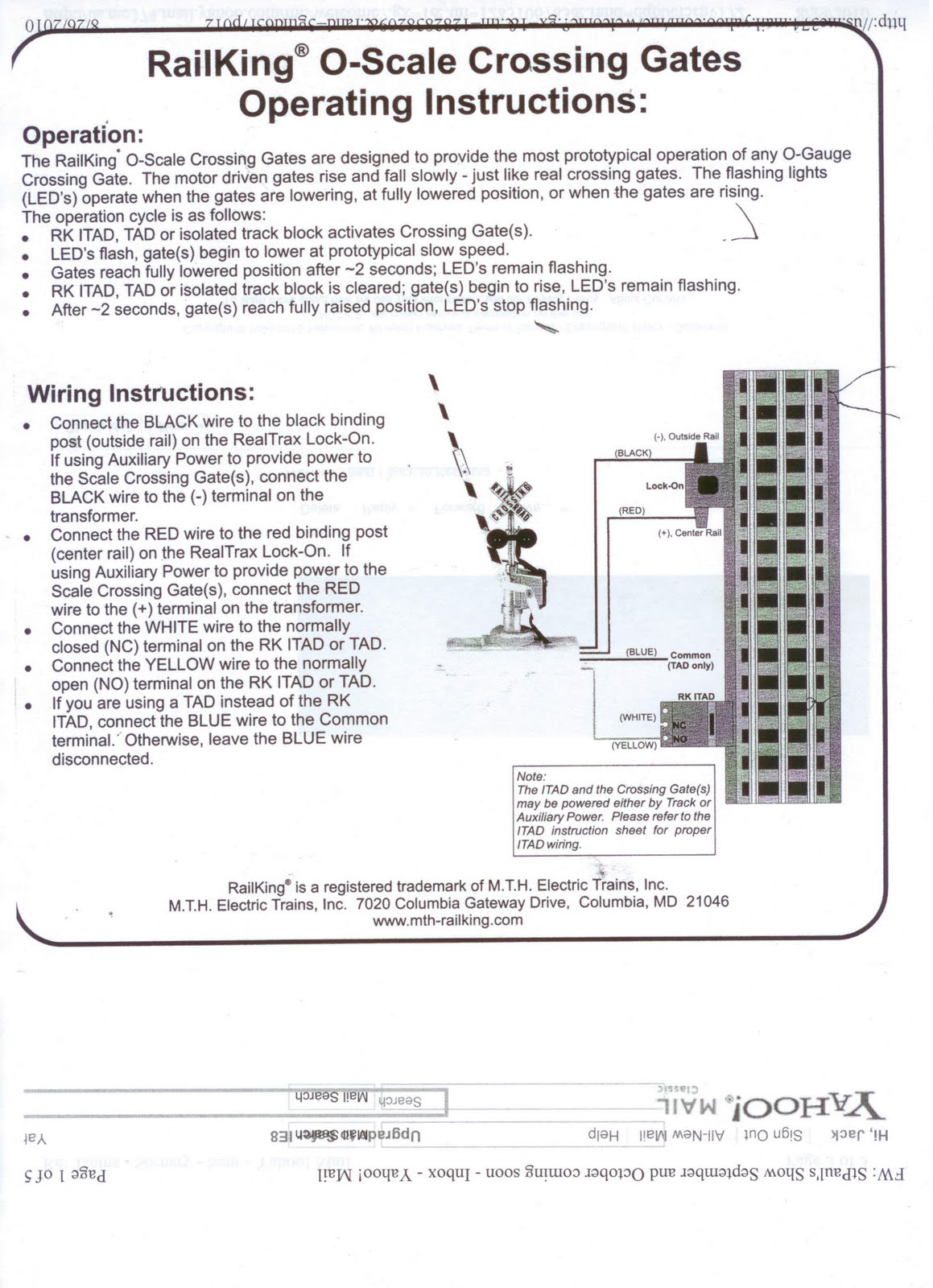
Crossing Gates Operating Instructions

I.T.A.D. Operating Instructions
I would appreciate any suggestions toward making the gates operational as described in the operating instructions.
Readers can comment below.
John has a wiring question for those in the know.
“1. I’m using fastrack- 8 switches on layout. Some of the switches do not operate very quickly. I’m powering my layout with A ZW Trans with two power boosters.
2. When I have two trains on track I cannot get them to go the same direction. Do I need a separate transformer for the track. It is all connected through with switches?
If you can help, Thanks”
Carolyn has a question for readers and ask:
“Hello, I am trying to find a transformer for a train that was my husband’s now deceased for my grandkids. He had a louis marx & co one but all it does is hum and won’t move the train. We took it out of storage and of course it was rusted tracks. We sanded them down hooked everything up and now the transformer won’t move anything but hum. How else is there things I can do. Will any transformer work or does it have to be exact like it. Please come back and help me. Thanks.”
Comment below.
John has a question for experienced model railroaders on wiring a loop.
“What is the best way to wire a loop to permit complete automatic operation? No electric switches to turn to reverse polarity. All automatic. and N scale.”
Comment below.