Everything on model trains, model railroads, model railways, locomotives, model train layouts, scenery, wiring, DCC and more. Enjoy the world's best hobby... model railroading!
Allan asks readers:
“I am using a Lionel O-Gauge Fastrack and wondered if I can setup my layout with the DCC System?”
You can comment below to assist Allan.
Patrick asks:
“My collection of passenger and freight cars is growing and it could be time to collate a maintenance schedule of some kind. Wheel sets, weight, couplers, loose parts, pivots, etc. Am I overthinking problems, or should I just look each one over or test for rollability before I put it on the track?”
Please add your COMMENTS under Patrick’s post.
There are many ways to construct bridges and the method used usually depends on the type, size, and style of bridge being built. This quick video demonstrates one popular method.
You can download the plans to build this and other bridges here
Richard has this question for readers:
“Hello, I have a Marx 999 and when applying power to the engine only the wheels spin and it doesn’t move. Is there an adjustment on the copper shoe? I can push the shoe and it springs back fine. When I give it a push it moves a little but stops and the wheels continue to spin? Thank you in advance.”
Randy asks readers:
“I am a newbie and am confused. I have two HO scale locos which are DCC. Both have been running. Now one still runs but one does not. When power is applied the loco begins the start-up sequence sounds but nothing else. I don’t know where to start.”
Craig has a question on Atlas switch machines:
“Can I use the track bus to power the switch machine or should I use a separate power source? I model HO scale.”
Shaun models N scale and has this question for readers:
“I’m tired of my NEM couplers uncoupling and was hoping for advice as to what these could be replaced with? Or for suggestions on how to keep them coupled?”
Please post your comments below to assist Shaun.
Duane asks:
“Super magnets – which are the best, spacing, any tricks or problems to know?”
You can post your comments directly below to have them published.

The above photo was snapped at the Carter Model Railroad Museum Train Show, ETSU, in Johnson City, Tennessee.
See the range of scale model house plans to download at

Here’s a scene with real depth. Snapped at the Warley National Model Railway Exhibition.
William asks readers:
“What is the best way to make N scale sidewalks and roadways? Thanks.”
Tony asks:
“I have never had a go with N scale, but have done HO operations. I raise this because I’m about to go with either HO or N scale for my new layout. Yard operations is what I like doing best so I assume with N scale I can probably do more in a smaller space. My reservation is uncoupling and coupling rolling stock and whether N scale is as easy as HO, or will I encounter more problems. I just thought someone might enlighten me. Thanks in advance.”
You can read and post your comments directly under this post.

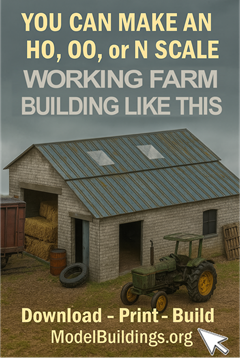
Download – Print – Build your own scale model farm buildings. See the range here
The reason some model train layouts turn out better than others often comes down to realism and aesthetics. To look realistic and not “toylike,” a layout should not be too predictable in design. A mainline running close to the edge of a standard 4ft x 8ft space and then curving at the end to form an oval will look “toylike” unless there is clever scenery or props to disguise the predictable track configuration. Where possible, it usually looks more realistic to include gentle curves (just like on a real railroad) and position the mainline at a slight angle from the edge of the benchwork. Hiding the curves with tunnels or hill cuts effectively distracts the eye from the fact that the train is running around an oval.

Another alternative is to make the layout point-to-point. Real railroads work this way so why not yours? Unless your whole purpose is to run the train in a continuous loop, a point-to-point layout featuring two separate industries or towns that exchange goods is the most realistic way you can operate. Remember, though, to figure out how to turn the locomotives around at each end. A turntable, wye, or reversing loop may be necessary but they also offer additional challenges as well as interest and convenience. The available space is obviously a big factor to also consider.
Tom has this question for readers:
“How far away from the turntable should I place my roundhouse? I model HO scale.”
Fred has a Vision line Big Boy and asks readers:
“I am looking for a video or info on removing the shell on my Vision Line Up Big Boy. I want to replace the smoke elements. It was sent twice to Lionel only to last for a short time. I have replaced elements on my diesel, but I am apprehensive about this large steam engine. Thanks.”
Post your answers or suggestions under this post if you can assist Fred.
Stephen models HO and asks:
“I’m considering using my own photos for my backscenes. I want to model the NSW east coast escarpment. Is there a company that prints individual photos as backscenes?”
Add your comments below.
Ryan shares this question:
“I know I got things wrong when I built my layout with 2ft x 4ft modules and had some flex track split on the curve. I shouldn’t have used flex track on the module joint…I know that now OUCH!! Is there a quick fix, or do I need to relay the track?”
If you can assist Ryan, please add your suggestion or comments under this post.