Everything on model trains, model railroads, model railways, locomotives, model train layouts, scenery, wiring, DCC and more. Enjoy the world's best hobby... model railroading!
Steven asks readers for advice:
“I have 2 North Pole Central passenger cars that had an unfortunate experience, they got hung up on the track and fried the wires inside. Is it any use to try to re-wire them or just pull all the wires out so they don’t short out on the track?”
Add your suggestions below.
Graham sent in an update on his layout:
“Hi guys. I’m a fifty two year old returner to the hobby after a twenty five year or so gap. Anyway I have built my new dream layout on two levels at 12 ft x 12 ft with a central operator island.I have four tracks in a radial pattern. On the top level one side has a dock area ,scenery includes a diorama with various shipping. The opposite side will be mining, as this will be an industrial plan, there will be very little housing or countryside.
I will have a turntable on the top level and the same on the bottom directly underneath. The top one will be set amongst the sheds, behind the through station and the bottom one be for turning locos to the shed area. The top tier has a cutout section or well to allow the top tier to join the bottom level via a sloping curve.
At the moment I am running the track from the top to the bottom. My next task is to overcome the double flap in the corner. This consists of two dropping flaps to allow access to my boiler for maintenance. This means getting track level and boards to align, good fun. I have just finished wiring two bus wires on both levels, wiring in turnouts. Next task turnout motors after teaching myself soldering.”
Comment below.
Here are a couple of questions that are fully answered in the online model train club members area.
In the meantime, readers might like to provide the answers:
George asks:
“How can I make simulated water. What material can I use to do a good job making water and make it simple for me.”
Gary asks:
“I know N guage is smaller that HO, but where does O or OO fit in?”
Richard asks:
“What are the 3 track rails used for?”
Add your answers below.
Add your suggestion below.
Guillermo, from the Patagonia Argentina has a question for readers:
"I want add overhead catenary line in part of my layout. I haven`t got information for a proper installation? Thanks for the help."
Add your comment or answer below.
I have a 8x4 layout which I need to suspend into the ceiling for storage. There are strong supporting beams in the ceiling and I have a well braced base board. Appreciate any suggestions. Thanks.
Comment below.

Norbert has a question for N gauge enthusiasts:
Are there instructions for installation of a micro-Tsunami digital sound decoder TSU-750 in a Model Power N-gauge 4-6-2 semi-streamline steam engine (No 87428)? I have checked their website with no success.
Answer below.
Stan asks experienced model railroaders for advice:
“I am limited for space. I am building a twice around HO 5′ x 9′ layout. I am planning on several turnouts and on going with DCC. What type of turnout works best … an Atlas Snap Switch or #4 Customline Switch? These turnouts are for spurs so it’s not necessary that I keep an 18″ radius. My concern is with the electrical continuity and shorting?”
Comment below.
Gary asks readers for advice:
I have a Hornby tender drive Flying Scotsman. The problem is that the 8 wheel tender derails regularly. Never the same position on the track, it appears random. It goes through points with no problem then derails on the curve or even on the straight. The affected wheelset is the last one. It derails when running light engine and when hauling coaches. I have checked the wheel back to back dimensions and they seem OK. Before I throw it as far as I can, does anyone have a solution?
Comment below.
Geoff asks readers:
“I have a DCC HO layout which is quite large so I have boosted the power to track to 4amps. My problem is the loco’s will run after pushing them but only for a short distance ie. a maximan 2ft. If I touch them even lightly the sound comes on and off but no movement unless pushed again and then only 2-3ins. I have tried all sorts of things like cleaning the track and so on so you can understand my frustration at building the setup but never had it run properly. I sincerely hope someone can help me rid myself of the frustration”
Add your answer below.
Charles has a question for those experienced with DCC:
“I have two E-7 units both with DCC. They are linked up in consist. When I run them the lead engine’s start to blink. I think this is an over heating condition. I am not pulling any cars at this point. Any ideas?”
Add your suggestions below.
If you are an experienced model railroader you might like to assist with answering one or more of these questions asked by readers:
1. Ken asks: "How do you make an old (1960's) HO locomotive run quietly?"
2. Mike asks: "What is the minimum realistic HO track radii"
3. Gary asks: "Can I get locomotive sounds for my HO DC layout?"
4. Val asks: "I have just started to build my railway in 00 scale. Can you tell me how wide the roads should be. Thank you."
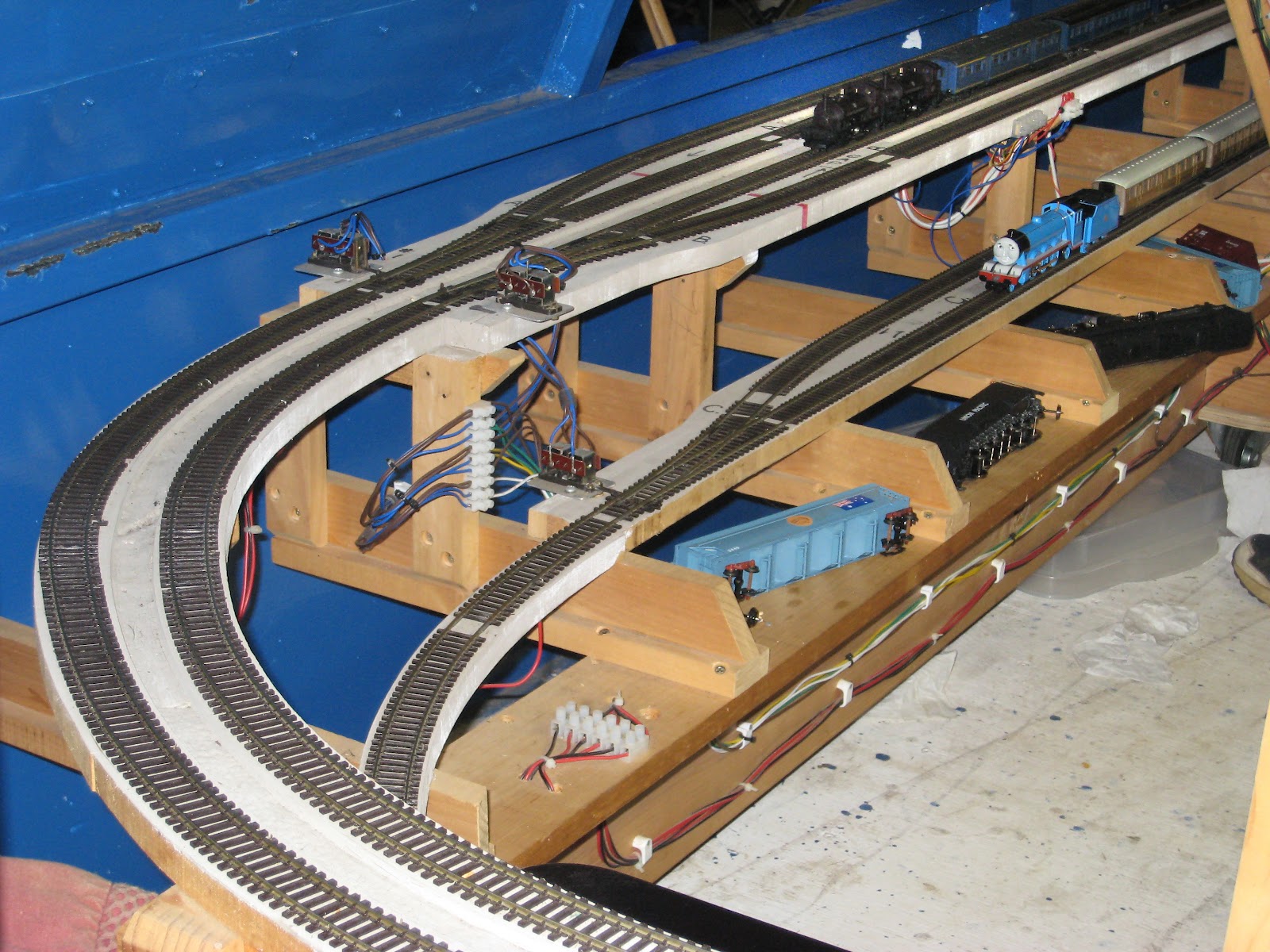
Model railroaders might want to try the “Odegard Squint,” named after famous model railroader Gordon Odegard (might be Odegaard). Just stand at one end of the layout and look at the track is at eye-level. Squint your eyes, and make sure all the track looks straight and there are no kinks or foreign objects on or near the track. Works every time!
For signs that are put on buildings such as industries, stores, stations, freight houses, etc., use heavier full-sheet label paper. Print the sign you want, peel off the back, and place the sign with the adhesive on it directly on the structure. However you make it, the sign is completely original, and use the money you save to make your layout even better!
Thanks John, you are making a wonderful contribution to the hobby.
The results of the recent poll revealed 51% of the 1047 model railroaders surveyed operate DCC. I actually thought the figure might have been a little higher than that (38% operate DC and 9% didn’t have a layout yet).
There are definite advantages for both systems, and I would never try and push anyone into DCC if they are already comfortable with DC and don’t want to change. That said; I would recommend DCC operation for anyone starting off in the hobby as the system is very versatile and fast becoming the norm. Whichever system you operate, always remember the whole idea is to have fun and enjoy what you are doing!
No matter if your layout is small or garage-sized, and though it is good to model a specific time period/road, the main consideration is to do what makes you happy. If you like to see a Burlington Northern SD pulling a string of old Central Pacific box cars, then go right ahead and know that no railroad “law enforcement” will arrest you for that. The layout is YOURS alone, and that’s what makes our hobby great!


A total of 483 model railroaders voted in our last poll which asked, “Which type of couplers do you use most?”
The results were:
Horn-Hook Couplers 11%
Knuckle Couplers 69%
Combination 14%
Other 6%