Construction
Everything on model trains, model railroads, model railways, locomotives, model train layouts, scenery, wiring, DCC and more. Enjoy the world's best hobby... model railroading!

Richard asks readers for advice:
“I just bought a new Lionel Trestle set for Fastrack. The plastic pins are not a joy to insert. Is there a trick to assemble them?”
Comment below
 If you have a model railroad question you would like answered, then use the link on this blog to submit your question. If you word your question carefully and provide some useful details, then chances are someone reading this blog will offer a solution. Only the best question will be published. Please spell check your question before submitting it to the blog moderator for approval.
The link to submit your question is on this page.
Ryan has put together this helpful tutorial for avoiding derailments on a model train layout. The video includes some excellent layout scenes. Feel free to pass it on to friends. Enjoy!
Paul is new to the hobby and asks a question:
“Hi, I’m doing my frist 00 layout and I am a bit confused what to use as the baseboard. The layout will be in my spare room so it won’t be going anywhere so I would like your readers views on this problem. Many thanks.”
I have a 8x4 layout which I need to suspend into the ceiling for storage. There are strong supporting beams in the ceiling and I have a well braced base board. Appreciate any suggestions. Thanks.
Comment below.
It is really handy to be able to easily move your layout (or sections of it) if required. Most people discover this when they move house. Moving the furniture is easy, but moving a layout can be problematic.

This informative manual describes how to build a mobile model train layout, so you don’t have to begin again when you move house. You can read how a modular train layout can save you money as well as taking up less space.
You’ll really enjoy this! It includes photos, tips and a layout plan included. Get it now for free when you join my online Model Train Club.

It’s a good idea is to paint the top of the baseboard gray when constructing your layout. Patches of track work where the ballast has not been secured properly will not stand out as easily. I know it is a simple idea, but it is amazing how many people don’t do it.
There are hundreds more great tips inside the members area of the online model train club.
Tom a keen member of the online model train club shares his idea:
These are a couple ways to build a sturdy but light platform for my S gauge layout. If you buy standard metal wall studs at the home center, say 10 ft. long, use these as the main outside and inside horizontal supports. You can put standard wood 1×4′s between the metal studs for leg support.
For the decking, take a hint from the Aluminum patio enclosure people. The roof sections they use are 4inch foam with thin sheets of aluminum sheets glued to top and bottom. Incredible strength. In the railroad application, use 2 inch or 4 inch blue or pink foam board and sandwich between thin sheets of plywood. You can glue more foam board on the top for the landscape.
John sent in this idea to share with readers:
There are many ways of making a platform on which to set up your tracks, trains, and scenery, and as model enthusiasts have found, foam insulation boards make a lightweight but strong and sturdy base. This is not the foam board made of styrofoam pebbles used for packaging that falls apart after awhile; rather, it is used mainly for structure insulation and comes in 2-feet X 8-feet lengths (see photo). This board is found in most home improvement stores, and comes in pink, blue, or green colors. There is even a 4 x 8 board that seems perfect for HO!
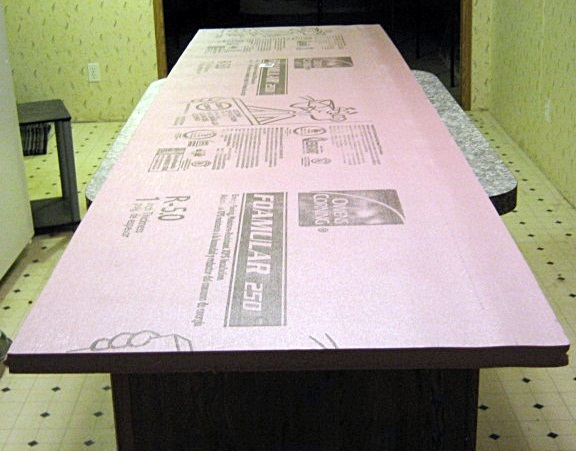
The foam insulation board comes in varying thicknesses, but I’ve found that one-inch and two-inches work best. This board can easily be cut to any size or shape (carefully) using a razor knife or Hot Wire Foam Cutter, and are readily joined using white glue and/or masking tape. Pieces of board that are left over can be used for all types of scenery – landscape, hills, and tunnels. There are some who make the entire train table and legs using foam insulation, but I would not recommend this. Just use the board as a horizontal base and you’ll have something that will last for years.
John kindly supplied this tip:
In keeping with Robert Anderson’s excellent Tip about using small layouts if you are strapped for space, a 2 x 4 N-Scale layout (or a Z-Scale empire!) is just the ticket. Get a 2 x 8, one-inch thick insulation board and cut it in half exactly, making two equal pieces that sandwiched together make a 2 x 4 super-strong two-inch base.
Paint the top, train-side part of the board with gray or earth-colored paint. Then the boards can go on an inexpensive 2 x 4 folding-leg table that is purchased at office supplies or home improvement stores. Put self-adhesive shelf paper on the sides of the boards, and secure the board-sandwich to the table with a few strips of the same shelf paper.
A small end table stored under the layout holds the power pack if you use one. Then the fun begins – use a good brand of track and trains, and even though it is a small layout, do not use too much track-to-scenery ratio (or vice-versa).
As a precaution, 11-inch radius N-Scale curved track comes too close to the edges on a 2×4 layout. Use 9-3/4″ radius curves, which lets you employ two-axle locomotives such as EMD F-Units and Geeps, ALCO RS models, and GE B-series U-Boats.
"Rather than using Standard MDF for your base you can buy MR MDF which is a moisture resistance MDF which we use for Kitchen Cupboards."
Comment below.
Bob writes:
“I have n gauge track fastened to homosote board. When the temperature changes the track will contract or expand to the point where the roadbed is disturbed. Can anyone give me any suggestions on how to prevent this from happening?”
If anyone can help this fellow railroader please reply below.
Parker has 3 questions to test everyone’s knowledge:
1. What size is HON3?
2. Is there a trick to bending the cork roadbed around a curve?
3. Is N minitrix a smaller size than N?
You can add your answers below.
Bob asks others in the hobby for advice:
“I have n gauge track fastened to homosote board. the track contracts and expands with temp changes in my basement. Are there any suggestions on how to stop the track from moving please.”
Add your comment below.
Bob asks readers:
“I have reached the point on my layout where I have to install trestles. I need to construct a jig in order to build the bends, this appears to be an overwhelming task. If the luck I’ve had so far is any indicator. ;o) Any help appreciated.”
Add your suggestions or ideas below.
Add your comments below.