Everything on model trains, model railroads, model railways, locomotives, model train layouts, scenery, wiring, DCC and more. Enjoy the world's best hobby... model railroading!
Phil wants suggestions from others in the hobby:
Hi all, first time poster here. I am looking for advice in upgrading my layout... here's the detail:

Over the past 7 years I've been building up my O collection... comes out and goes under the tree each year. The layout has grown in size and accessories, and I have a collection of different types of locomotives. Here are some key highlights:

- track layout is essentially 2 interlocking ovals (all standard o gauge tracks - the 3 rail metal ones)
- 4 powered switches 6-14062/3
- 1 electric gateman
- 3 other powered accessories (light up bridge, dog chasing the postman, etc)
- 1 utility/coupling track
- 1 transformer/controller (Lionel 6-14198 80 Watt Transfrmr/Cntrlr)

Engines include:
- 2350 New Haven EP-5 Pwd. Electric Locomotive
- Hudson New York City Locomotive 6-28044
- Rail King RTR Subway Train Set 30-4122-1
- Thomas the Train Engine
- Various other cars

The bad news:
- I've noticed some of the trains slowing down and even stopping around my layout
- with 2 dogs and 2 small kids, it is sometimes challenging to keep the area neat, wires connected, etc

The good news:
- the wife has commented about all the wires and having to sit on the floor next to the couches to run the trains (the door is open for an upgrade!)

My questions:
- I suspect I may need a more powerful transformer (maybe a ZW) to go with this - I am only using 1 lockon to drive power to the track... will a 2nd lockon help?
- how do I upgrade into the 20/21st century with a hand held remote?  I've seen the "legacy" command and control modules at train shows - is this the best bet?
- I understand that many of the new locomotives are being built optimize the control experience, but I also have mostly older engines that I would want to make sure still works
- are the command/control centers capable of controlling my switches as well (and eliminate more wires?)

Any help/advice is appreciated
1. Are they trouble free

2. I am running DCC Insulfrog or Electrofrog?

3. Any special tips
Comment below.
Frank is looking for advice from anyone who has experience building scenery and structures:
“On a large HO layout I want to use an old grist mill with a dam and running water over a water wheel. #1 I’m concerned the water may have a corrosive problem for the train? Will it? #2 Is there a good substitute for water without the problem of corrison. Forgot to mention I would like to add a waterfall (apprx 12- 15″) close to the mill site. Thanks.”
Add your answer or suggestion to help Frank.

You could use a copper-tone stripe to represent the rusty band on a tank. There are lots of uses on a model railway for pin stripes. Another is for bands around wine barrels if you have a winery on your layout. You can paint the pin stripes if the color you want is not available, which is still easier than trying to paint a straight line…believe me.
Cedric who is a member of my Online Model Train Club sent in his thoughts on pricing secondhand trains.

Because I have been in the hobby about 40 years and attend lots of train shows I get asked a lot about the value of secondhand trains. It is difficult to give an exact answer because it really depends on what some will pay on the day and how many buyers there are for that particular loco or car.
A lot also depends on whether the item has been modified, weathered, or is in its original condition with original boxing. Depending on the brand and condition, sometimes the value will increase if the loco or rolling stock has not been modified in any way.
In general I have found that weathering will devalue the item useless it has been done to an extremely high standard, in which case the reverse could apply and the value increase. Cars that are factory weathered can retain their value as they are factory stock as opposed to being modified by a home hobbyist.
Rare items (such as rare brass locomotives) should increase in value, but modifications to the factory paint and finish of rare items could devalue them.
When it comes to rolling stock, the value can increase based on any upgrades such as the addition of better trucks and metal wheels etc. A buyer might be prepared to pay a little more for upgrades if it saves them the cost and effort of them having to upgrade the item.
A final tip is to keep all the packaging and printed instructions that originally came with the item. This will help the resale value if or when you come to sell.
It was interesting to see the results of the last poll when we asked “Do you operate DCC, DC, or Live Steam?”
A total of 647 people responded which is a big number.
47% (309) said they operated DCC, 34% (223) answered DC, 2% (15) Live Steam, 3% (24) said some other system, and 11% (76) said they didn’t have a layout.
So, although the trend is toward DCC there are obviously still a lot of people operating DC.
Art has a question for N scale enthusiasts and asks:
“N scale Kato Turnout controls – what other cheaper toggle switches can be used for Kato N Scale turnouts and how do you attach switch direction LEDs on the control panel and on the turnout track indicating direction? Also if you have parallel controls on different sides of a layout, what is the best way to wire switch controls and lights? Thanks for the input.”
Comment below.
Rudy asks readers:
“Is there any such thing as rust colored paint? I have been unsuccessful trying to blend paint to simulate rust on my stock. It doesn’t look realistic. I would appreciate any ideas. Thanks.”
Add your answer below.
David wants advice from readers on ballasting:
“I am attempting to use percolated coffee grounds as ballast in my large main switch yard. The color is perfect for a heavily oiled track-bed. The problem I encounter is that, since there are oils in the coffee grounds, the regular ballasting methods of applying alchohol followed by a diluted glue solution will not keep all the grounds together. After drying, when I use a vacuum to suck up the excess, some large pieces of ballast are removed. Obviously the oil effect of the coffee grounds doesn’t allow for good adhesion. What can I do to remove the oil from the grounds prior to ballasting?”
Add your comments below.
Tom asks for help from readers who have a mathematical mind:
“I’m trying to build my first layout and having trouble converting the scale layout to life size. The scale is 7/8 inch = 1 foot. If that is so then what does each 1/8 inch equal in life size?”
Add your comments below.
Here is a tip supplied by RussellM who is a member of my online Model Train Club:
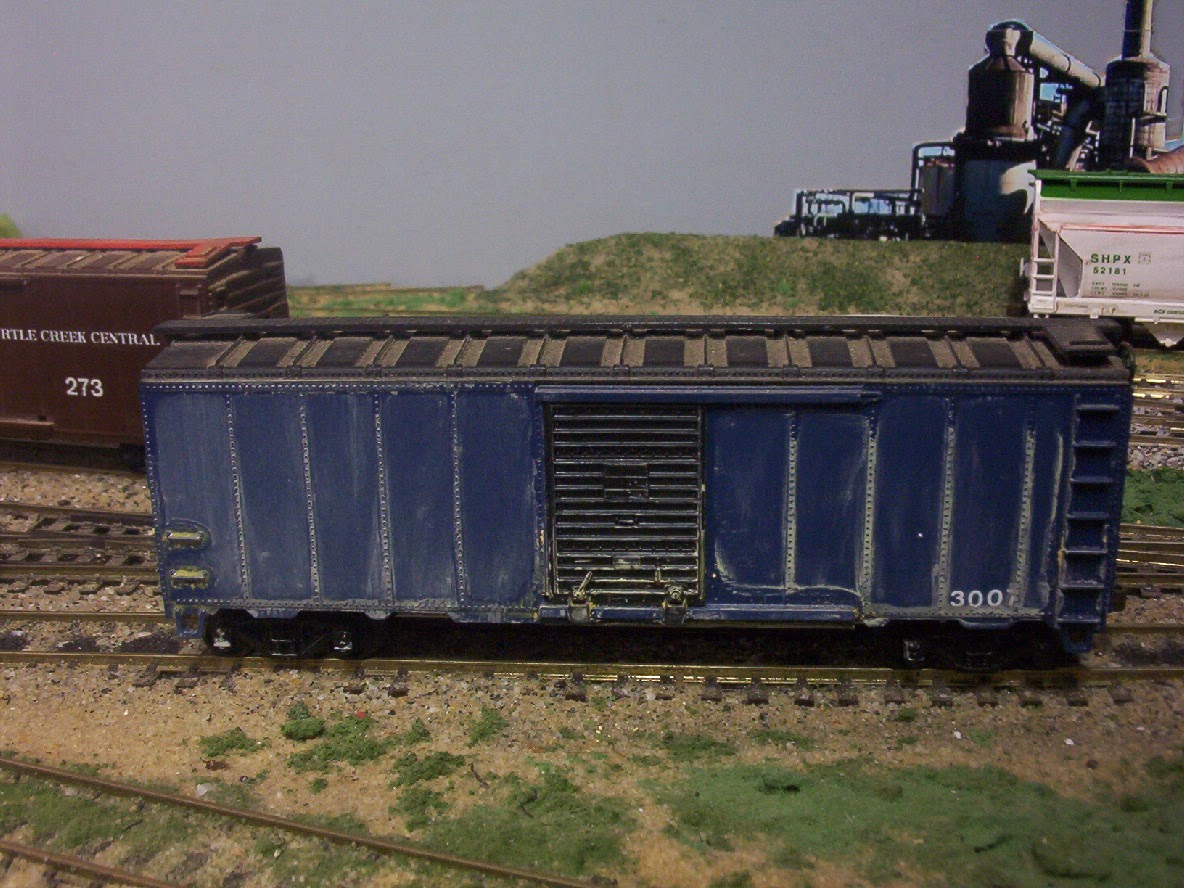
Have a go at using a small piece of wire to dab on spots of rust paint. Let dry a little before you lightly brush it down to simulate the rust running down the sides of the car. You simply use a single strand of stranded wire.
Here are some excellent suggestions sent in by Harold who is a member of my popular online Model Train Club:

Most of us have far more cars (rolling stock) and locomotives than we can possibly operate at once. One option is to simply store excess cars and locomotives in boxes or on display shelves or cabinets. It is possible, however, to store all of your extra equipment on tracks in a yard that may, or may not, be part of the visible operating portion of your layout.
Here are some tips if you are planning on building a rail yard:
1. Try to incorporate at least one staging track with it connected to the main track at both ends. If you have room for two, then even better. The purpose of yard (apart from storage) is to collect incoming cars, rearrange them and get them on trains that will take them to their destinations. The key is to have enough space to do this efficiently.
2. Try not to cram too many tracks into a small space. If the tracks are too close together it could cause a domino effect if a car derails.
3. Always plan an escape route and avoid having spur tracks that could trap your locomotive behind a line of freight wagons.
4. Keep your yard design simple. A complex design can lead to more potential problems even with a simple mistake.
A yard should be relatively easy to get in and out of. Keep the design simple and the operation will be simple too.
Here is one of the hundreds of useful tips available to members of my online Model Train Club.

Toning Down Colors
Here’s something I’ve discovered. I no longer use white or black paint on my layout without mixing in other tones. I find pure white and pure black a little stark and unreal as those colors stand out too much! I also stick with matt paints (not gloss) on most things. Gloss might look ok on a shiny new loco, but it looks too unreal on most things. To tone down black or white paint I usually add a small drop of another color such as diluted brown just to take the starkness away. Remember with white to just add a tiny dab of another color, because if you add too much you’ll have to add a big quantity of white to overcome the problem. If you add too much brown for example, you might be best to pour it out and start mixing again.
Here is a tip sent in by a member of my online Model Train Club. There are hundreds more inside the members area. To join see the link in the right column.
I took some digital photos of the displays in some local shop windows and reduced them on my computer and printed them out so they fit the scale of my buildings. I glued them in place and covered them with some clear acetate to represent windows – you could use recycled clear plastic lids.
Vinny asks readers for help:
“I have a new MTH Proto 2.0 engine. I am trying to run it in conventional mode (do not have DCS command system). The loco won’t run. The lights come on, the engine chatter works. When I increase the voltage, the horn comes on and will not shut off. I charged the battery with MTH proto 2.0 charger and have the same results. What else can I do?”
Add your suggestion below.
"Rather than using Standard MDF for your base you can buy MR MDF which is a moisture resistance MDF which we use for Kitchen Cupboards."
Comment below.
Derek asks:
“Hi are there any books that give you the circuit details for building digital controllers and receivers? DCC I had an old article in Practical Electronics 1980 for the main controller but lost the 2nd article on receivers.”