Everything on model trains, model railroads, model railways, locomotives, model train layouts, scenery, wiring, DCC and more. Enjoy the world's best hobby... model railroading!
There were 1371 votes from 732 respondents in our recent poll which asked, Which decade do you model?
Respondents could select more than one era if required, hence the difference in numbers.
The numbers favored the timeline from 1940 to 1970 with 713 people registering a vote. 1950 to 1960 recorded the highest results (312 people model that decade).
Full details are as follows:
Pre 1900 = 37
1910 -1920 = 36
1920 -1930 = 65
1930 -1940 = 115
1940 -1950 = 224
1950 -1960 = 312
1960 – 1970 = 177
1970 -1980 = 110
1980 – 1990 = 77
1990 – 2000 = 71
2000 -2010 = 76
2010 – Present Day = 71
No particular era = 129
Ted wants advice from others in the hobby and asks:
“I have a few PK2000’s and suffer gear problems like everybody. However a new problem is the front gear box on my GP9 has seazed. The flywheels turn, the rear drivers turn and the front drive shaft turns,but the front drivers gears are locked. I need to remove the motor and gear boxes, but can’t figure out how to do that. Any suggestions? Thanks.”
To assist Ted comment below.
Liter has a question for anyone with Z scale experience:
“My current Z scale engines and rolling stock all have Marklin type couplers. Unless you purchase Marklin equipment, these couplers seem to be unavailable from other suppliers. For example, Micro Trains and AZL seem to have there own types of couplers. My question is: How many kinds of couplers are there and how can I be sure the new pieces of non-Marklin equipment I might buy have compatible couplers?”
Comment below.
Pete would like to hear what others in the hobby think about…
“Can an older HO diesel engine (Bachmann) be converted from dc to dcc? What is necessary to do this.”
Add your thoughts using the comment link below this posting.
Christy is hoping for some advice from readers:
“I have seen a video of a model railroad where they used I think some sort of hobby motor to make a figure, and tow motor move, and other things move. Please tell me what and how to use add this element of motion to my G scale display. Please give ideas on where to order the parts for this also. Thanks for your help.”
Comment below
Dick has a question for readers:
“I have DCC on my HO layout. The engines short out sometimes when traveling slow on the turnouts. How do I cure this? (I use #6 Shinohara turnouts).”
If you can assist Dick, add your comment below.
A reader asks:
As most model railroaders have TOO many Locomotives and Cars. It would be interesting to know what the recommendation would be for the following -
How many locomotives per sq. ft of Layout? How many Cars per sq. ft. of HO Layout?
Submit your answer below this posting.
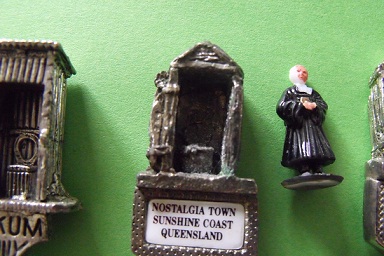
If anyone else wants to share some creative scenery ideas, please submit details using the Ask A Question link below. Approved ideas will be published in approx 7 - 10 days.
Richard has a question for others in the hobby:
“I know about HO turn tables, wyes and reversing loops at the end of a line. Are there any other ways to turn a train, or even just a locomotive around to head back the other way? I’m thinking mostly of passenger trains, with all the seats facing forward and I don’t want them to have to ride backward, or to manually reverse each car.”
Comment below.
Owen sent in this tip to share:
A snagging train coupler can also cause derailments. Unpolished couplers (particularly on new cars), can catch and bring about derailments.
It pays to clean away any rough edges and if necessary adjust the couplers so they center properly. Some coupler brands and particularly older couplers are hopelessly uneven in heights. The key is to have then set at the same height where possible. And, it is a good idea to stick with one brand so you become familiar with how they perform. Mixing brands like Hornby and Bachmann can sometimes be problematic.
Derek has sent in this tip to share:
Having the wrong track gauge is a common cause of derailments. Having a tight track gauge may cause the wheels to ride up and derail. However, having a wide track gauge can also result in derailments when the wheel flanges don’t span the track properly.
One can adjust gauge by the use of spikes to hold the track down in gauge. The rail can also be gently heated with a soldering iron, and moving the rail to its correct position before letting it cool down.
Another thing I do is check the points for sharpness as they switch. Some newer switch points can be somewhat blunt on the movable section where it strikes against the stock rails. If this happens it can lift, or jolt, the wheels and end up derailing the train. Take a small file and gently smooth the moveable part of the points to achieve a smoother transition. Always check the gauge in both positions.
In the last poll we asked “Do you operate DCC on your layout?”
Well, the results were very interesting….
1047 had their say…
Those who said YES I operate DCC = 538 (51%)
Those who said NO I don’t operate DCC = 406 (38%)
Those who replied – I don’t have a layout yet = 103 (9%)
The latest poll question about train eras was sent in by Richard – thanks Richard.
If you would like to suggest a poll question, simply use the “Ask a question” link at the bottom of this blog.
Frank wants advice from experienced model railroaders on how to keep his track, cars and locos clean. If you can offer a suggestion, then please add your comment below:
“I clean my tracks, rolling stock and engines with goo gon. I was informed that this leaves an oily residue. Is this so? Tracks I clean with a clean white rag. I use white paper toweling socked with goo-gon layed over a section of track and roll my rollig stock over it. I then roll it over a dry paper towel until clean. Engines I do in the same manner except I use the power to spin the engine wheels. After a short period of time; less then a week the tracks are back to being dirty again. Another point: someone told me they use moleskin pads on a cheap track cleaning car and run it around the tracks. Again the tracks get dirty within a week or so. Any Suggestions.”
Jonathan has an HO layout and is wanting advice from anyone with experience with couplers:
"I have IHC 85 pass. cars w/plastic trucks and McH knuckle type couplers. These wheels (#33) seem to drag when on the track but roll freely if rolled by hand. Does anyone have any ideas?"
Add your suggestions using the comments link below.
Richard asks readers:
“I’m starting on a 4×8 layout with double ovals and a small yard inside the inner oval. im running on DC for now. I have a loco that can also run on dcc. My question is can I just switch over to DCC even if my switches are insulated Atlas switches? Any special wiring I need to know about? For now my layout is just flat landscape.”
Add your answers below to help Richard.
Stephen asks readers:
“In a recent model railroad planning magazine, there was an article titled ‘How to Plan Concentric Curves with Easements’ by Van S Fehr. The article made reference that the author placed an Excel Spreadsheet ‘on the web’ that performs the calculations for the Seven-Step Procedure. Does anyone know how to find this spreadsheet? I’m building a new layout and need this type of information.”
To answer this question, and if you think the spreadsheet Stephen is looking for is available free, use the comments link below.
Gale asks readers:
“I have several Concor brown box collector set in N scale and I want to convert them to DCC. Where can I find the Information on how to do this?”
Add your answer below.
John has very generously sent in this idea to share with others in the hobby:
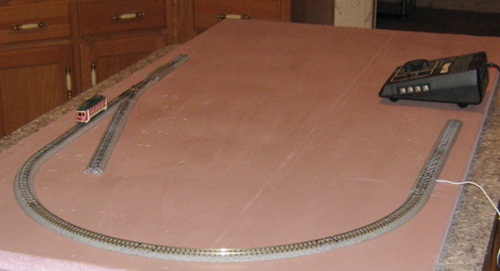
Whether you have a small layout or a room-sized empire, it’s essential to test the track as you build. One way of doing this is to use an older, inexpensive, or seldom-used locomotive to run over the track as you check for bumps, kinks, and other obstructions. If this locomotive runs fairly well, then your “good” engines will run like clockwork. However, it is important to see that this test locomotive actually runs and runs well enough to try out the track.
To Pre-Test the Test locomotive, which takes a short amount of time, set the track up in a semi-circle. Include straight, rerailer, curved, and small-pieces of track, along with a switch and siding, hooked up to a power pack (as shown in the accompanying photo). I used Kato N-Scale Unitrack and a small trolley, and slowly ran it in both directions, watching for hesitations, stops, derailing, and slowing down with flickering lights on the straights and curves, and looking for stalling in or out of the switch. A lot of locos hesitate slightly on switches, but should only stall out or derail if the switch is set improperly.
If your locomotive passes this Pre-Test, then it can be used as you put down track on your layout. By doing this small test, which only takes a few minutes, it gives you a reliable locomotive that has a “purpose in life” while your more-expensive diesels, electrics, and/or steam engines run on your layout.